La Máquina: How Argentina's AI-Simulated Run to the Semi-Finals Was Built on Goals, Grit and Messi's Magic
From a routine Group J opener against Algeria to a breathtaking extra-time thriller against Brazil, Argentina's road to the final four was a masterclass in collective brilliance — and one last Messi act of will.
The Machine Warms Up: Group J
Argentina arrived at this AI-simulated World Cup carrying the weight of reigning champions, and they wasted no time reminding the tournament who they were. In their Group J opener (2026-019), Lionel Messi opened the scoring against Algeria at the 18th minute — a free kick so precise it might as well have been a signature — before Julián Álvarez doubled the lead on 37 minutes. Riyad Mahrez pulled one back for a spirited Algeria side just before the hour, but Lautaro Martínez sealed it at 74' to make it 3–1. The trio of Messi, Álvarez and Martínez had announced themselves as the tournament's most dangerous attacking unit in a single afternoon.
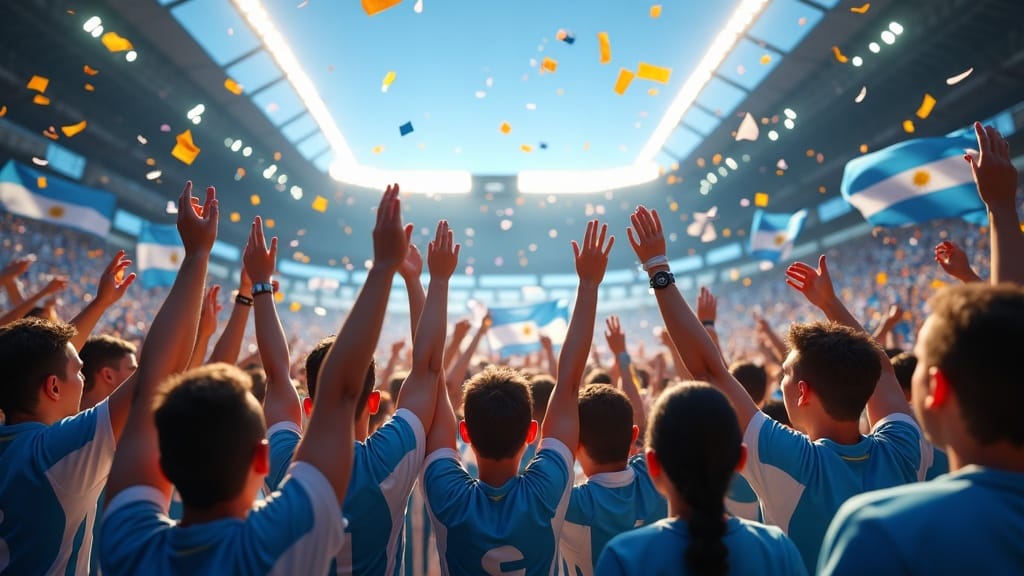
The second group match against Austria (2026-043) followed the same ruthless template: Messi again on 18 minutes, Álvarez again on 34, and Martínez wrapping it up at 78' for another 3–1 win, with Christoph Baumgartner's goal a mere cosmetic consolation for a well-organised Austrian side. By the time Argentina dispatched Jordan 3–0 (2026-070) — Messi, Álvarez and Martínez each adding another to their tallies — the pattern was unmistakable. Argentina had scored nine goals across three group games, conceded just one, and their front three had accounted for every single strike. Álvarez and Martínez each finished the group stage with three goals apiece. The AI's model had identified Argentina as a tournament-winning machine; the results were merely the printout.
The Knockout Tests Begin: Uruguay and the United States
The Round of 32 handed Argentina a derby with Uruguay — a fixture that needs no extra spice but always finds some. In a tense encounter (2026-086), Messi broke the deadlock on 34 minutes with a curling effort that replays will loop for years. Darwin Núñez, Uruguay's talismanic striker, equalised on 61 minutes to set nerves jangling. But Álvarez, composed as ever, won it on 78 minutes to send Argentina through 2–1. It was the kind of result that defines campaigns: ugly enough to be real, decisive enough to matter.
The Round of 16 pitted Argentina against a host-nation United States side riding a wave of extraordinary home support across the three co-host nations (2026-095). The atmosphere was electric, but Argentina were clinical. Messi opened the scoring on 22 minutes — his earliest goal of the tournament — before Christian Pulisic levelled for the USMNT on 41 minutes, briefly silencing the travelling Albiceleste faithful. Álvarez restored the lead on 67 minutes, and Martínez put the result beyond doubt on 84'. The 3–1 scoreline flattered neither side, but it underlined a brutal truth: when Argentina's front three fire in sequence, there is no answer.
The Quarter-Final: Portugal Slain in Extra Time
Argentina's quarter-final against Portugal (2026-100) was the match the tournament had been building toward — a collision of footballing philosophies, generational pride and, inevitably, the long shadows of Messi and Cristiano Ronaldo sharing a pitch one final time on the grandest stage. Lautaro Martínez gave Argentina the lead on 38 minutes, but Bruno Fernandes — imperious throughout Portugal's campaign — equalised with a driven effort on 71 minutes. Ninety minutes were not enough. Into extra time, and it was Julián Álvarez, the tournament's joint top scorer with eight goals, who settled it on 104 minutes with a composed finish that sent the blue-and-white half of the stadium into delirium. Argentina were in the semi-finals.
The Semi-Final Epic: Argentina 3–2 Brazil AET
If the quarter-final was the match the tournament craved, the semi-final against Brazil (2026-102) was the one it deserved. A South American final-four clash played on North American soil, dripping with history and mutual obsession. Vinícius Júnior put Brazil ahead on 23 minutes with a finish of electric simplicity, but Martínez — who had been Argentina's most consistent performer across the knockout rounds — levelled on 41 minutes. Raphinha restored Brazil's advantage on 68 minutes, and it looked as though the Seleção would end Argentina's dream. Then Álvarez, with eight goals to his name and ice in his veins, equalised again on 84 minutes to force extra time. In the 109th minute, Martínez — his tournament tally now at eight goals — struck the decisive blow. Argentina had won 3–2 in extra time, their greatest performance of the campaign, and booked a place in the final against France. The machine had not broken. It had only grown stronger.
Related Matches







AI-generated predictions — not real results. Not affiliated with FIFA, its member associations, teams or players.