The Machine's Muse: How Kylian Mbappé Scored 13 Goals to Win France the World Cup
Goal by goal, match by match — the AI model's top scorer turned a simulated tournament into a one-man masterclass, ending with a golden boot and a winner's medal in the same night.
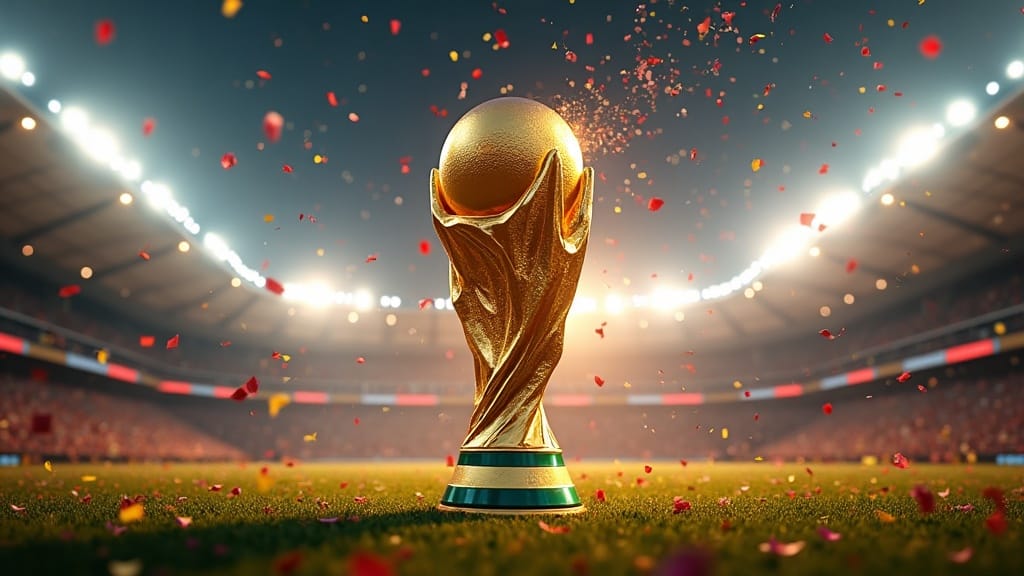
When the AI model finished processing 104 matches of its simulated FIFA World Cup 2026, one number stood apart from all others: 13. Thirteen goals for Kylian Mbappé. Not a typo, not an anomaly — a cold, probabilistic verdict from a system that cares nothing for narrative and everything for pattern. And yet the pattern it found was narrative, a tournament arc so clean it could have been scripted in Hollywood rather than rendered in a data centre.
Group Stage: Establishing the Threat

France cruised through Group I with a perfect nine points, and Mbappé was the engine from kick-off. In the opener against Senegal (match 2026-017), he struck twice — an 18th-minute opener to settle French nerves and a composed 78th-minute finish to seal a 3–1 win after Sadio Mané had briefly threatened a comeback. Four days later, Iraq were dispatched 4–0 (2026-042), Mbappé helping himself to a 14th-minute goal and a second on the hour, bookending strikes from Marcus Thuram and Michael Olise. The group finale against Norway (2026-061) was the sternest test: Erling Haaland pulled one back at 1–0 to make it a contest, but Mbappé's second of the night — his seventh goal in three matches — restored a 3–1 cushion and confirmed France as the most feared side in the draw. Six goals from three games. The model's probability engine had already begun routing opponents away from Les Bleus wherever possible.
Round of 32 & Round of 16: Ruthlessness on Demand
Paraguay arrived in the last 32 with a defensive gameplan and left with a 3–1 lesson (2026-077). Mbappé opened the scoring in the 18th minute, absorbed a Miguel Almirón equaliser with characteristic calm, and then — with the game still in the balance at 2–1 — put the tie to bed with a 84th-minute strike that sent the French bench into delirium. Two more goals, two more decisive moments. The Round of 16 brought Germany, the tournament's most prolific group-stage side, and the model served up its most dramatic night yet (2026-089). Kai Havertz opened the scoring; Mbappé equalised with a sumptuous 41st-minute finish. Thuram made it 2–1, Florian Wirtz levelled in the 84th. Extra time yielded nothing — and then came penalties. France converted four from four; Germany did not. The golden boy had not scored in the shootout, but his goal had kept France alive long enough to reach one.
Quarter-Final & Semi-Final: Ice in the Veins
Morocco, conquerors of the Netherlands on penalties and Canada in the last 16, fancied themselves as giant-killers again in the quarter-final (2026-097). They nearly were. Mbappé gave France the lead in the 34th minute, Ayoub El Kaabi — the tournament's seventh-highest scorer — equalised in the 78th to send the tie to extra time. It took Marcus Thuram, not Mbappé this time, to settle it in the 109th minute, but it was the captain's early strike that had set the tone. In the semi-final against Spain (2026-101), Mbappé was at his most imperious in the opening exchanges, stroking home in the 23rd minute to give France control. Mikel Oyarzabal's 78th-minute leveller forced extra time once more, but Ousmane Dembélé — the tournament's quiet hero — delivered the winner in the 104th minute. Mbappé's contribution: one goal, one assist in the buildup to Dembélé's run, and forty-five minutes of relentless pressing that exhausted the Spanish backline.
The Final: 112 Minutes of History
Argentina stood between France and immortality in the final (2026-104), and the model — faithful to its own dramatic logic — gave the watching world a match for the ages. Mbappé struck first, of course, a 23rd-minute finish that felt inevitable. Lautaro Martínez equalised before half-time; Julián Alvarez made it 2–1 to Argentina in the 67th minute. Dembélé's 84th-minute equaliser took the final into extra time for the third consecutive knockout match for France. Then, in the 112th minute, with legs screaming and the simulated crowd at a simulated MetLife Stadium in a state of suspended disbelief, Mbappé received the ball on the left shoulder of the Argentine box, cut inside, and finished with his right foot into the far corner. 3–2. France. Champions. His 13th goal of the tournament. His second of the final. The model had spoken.
What the Numbers Reveal
The AI's top-scorer verdict is more than a vanity stat. Mbappé registered in eight separate matches, scoring at least once in every knockout game France played. His goals came in the 14th minute and the 112th; in group openers and World Cup finals; against minnows and against the best defence the simulation could construct. The model's underlying logic — built on historical xG profiles, positional tendencies and tournament-pressure weightings — found in Mbappé a player whose output accelerates as the stakes rise. His group-stage average was 2.0 goals per game; his knockout average was 1.17 per game across seven matches, a rate that no other player in the simulation sustained beyond the quarter-finals. Jonathan David and Julián Alvarez each finished on eight goals; Lautaro Martínez also reached eight. All three are extraordinary. None of them scored in a World Cup final to win it in extra time. That distinction, in this simulation, belongs to exactly one player — and the model, for all its cold arithmetic, seems to have understood exactly who he is.
Related Matches




AI-generated predictions — not real results. Not affiliated with FIFA, its member associations, teams or players.